Expert’s Desk · Knee
Is joint cracking (crepitus) harmful? Does knuckle cracking cause arthritis?

Short answer
Painless joint cracking (crepitus) is harmless in most cases and is not, on its own, a sign of disease. The "pop" you hear when cracking a knuckle comes from a gas cavity forming rapidly in the joint fluid (cavitation) — shown directly with real-time MRI. There is no evidence supporting the widespread belief that "knuckle cracking causes arthritis"; both long-term observation and comparative studies have found no arthritis difference between people who crack and those who do not.
What matters is not the sound itself but whether it is accompanied by pain, swelling, locking, or a sense of the joint giving way. Avoiding sport or movement because of a silent crack (a form of movement fear) is often more harmful than the sound itself. If there is only sound, there is no need to worry; if symptoms such as pain and swelling accompany it, an evaluation is warranted.
Contents
Why does cracking happen? Cavitation and tribonucleation
Joint cracking is something people quietly wonder about but rarely ask. Where that distinct "pop" in knuckle cracking comes from was debated for a long time. The real-time MRI study by Kawchuk et al., published in PLoS ONE in 2015, answered the question directly with imaging: the moment the joint surfaces separate, a gas cavity forms rapidly within the joint fluid, and the sound occurs precisely as this cavity forms. So the sound comes not from a bubble "bursting," as once thought, but from the cavity forming (a process called tribonucleation).
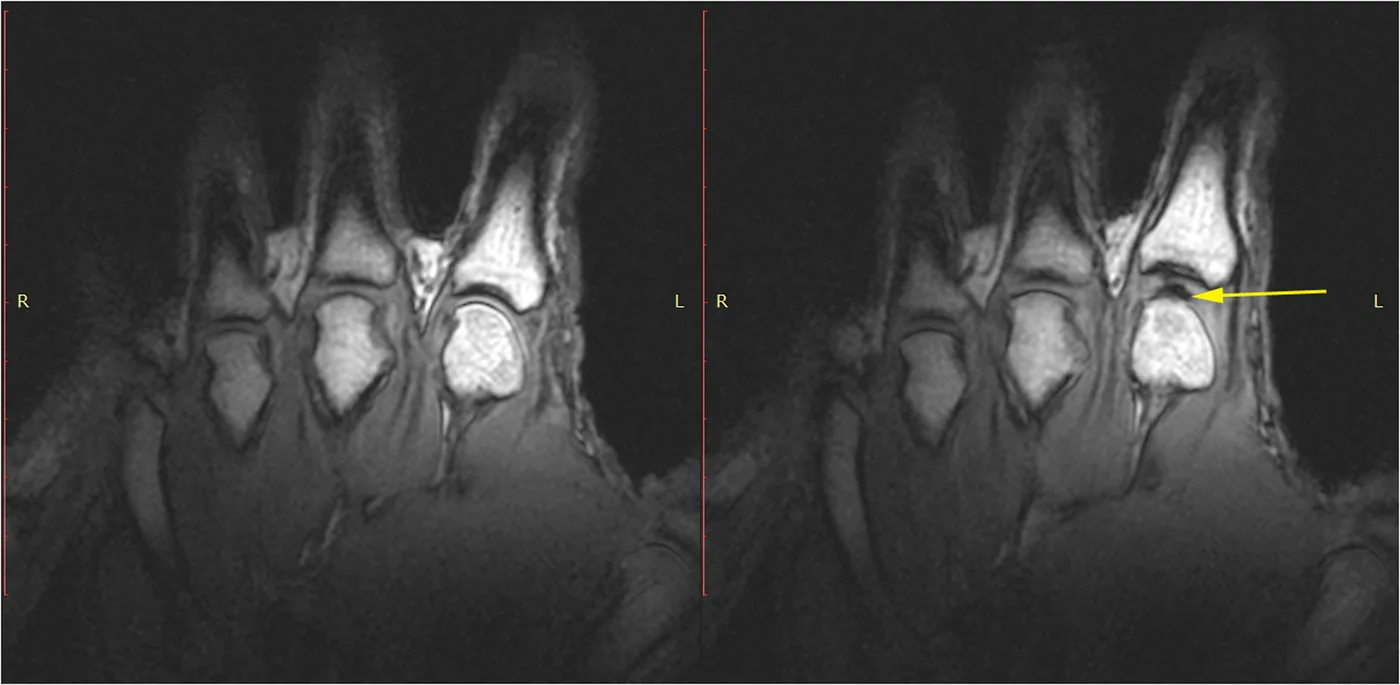
The key point: this is not cartilage wear or a damage process; it is an entirely mechanical, benign event related to the physics of the joint fluid. The reason you have to wait before you can crack the same joint again is that it takes time for the gas to redissolve into the fluid.
Does knuckle cracking cause arthritis? Busting the myth
This is one of the most common health myths — but there is no solid evidence behind it.
- Unger's 60-year observation on his own hand: One physician cracked the knuckles of only his left hand at least twice a day for over 60 years, and never cracked his right. When he later compared the two hands, there was no difference between them and no sign of arthritis in the cracked hand (Unger, 1998). Although a single-person observation, it is a striking and memorable counterpoint to the myth.
- Comparative studies: More systematic data point the same way. In deWeber et al.'s (2011) case-control study of hand osteoarthritis, the prevalence of arthritis in any joint was similar between crackers and non-crackers; cracking did not emerge as a risk factor for arthritis in that joint.
In sum: the available evidence does not show that habitual knuckle cracking causes arthritis in the fingers. (Note: this does not mean "no one ever has any problem"; there are rare reports of transient swelling or reduced grip strength with excessive, forceful cracking, but the arthritis link is not supported.)
Knee crepitus and the fear of osteoarthritis
Cracking or grinding from the knee is among the sounds that worry people most; many live with it under the fear "am I wearing out?" Here too the evidence is reassuring:
- Crepitus is very common even in healthy knees and is not, on its own, a sign of disease or wear. In de Oliveira Silva et al.'s (2018) study, although crepitus was common in women with anterior knee pain, the presence of the sound was not related to function, physical activity, or pain level — so the equation "lots of cracking, therefore things are bad" does not hold.
- The same holds over the long term: in Pazzinatto et al.'s (2019) longitudinal study using Osteoarthritis Initiative data, baseline knee crepitus was not associated with the need for a knee replacement (total knee replacement) in the following period.
So knee crepitus is not the "sound" of disease. What matters is whether other symptoms accompany the cracking: if there is pain, swelling, locking of the knee, or a sense of giving way, then evaluation is warranted — but what triggers that evaluation is those symptoms, not the sound. For the central role of exercise in managing knee osteoarthritis: does exercise help knee osteoarthritis?.
"It made a sound, so I'll stop": the truly harmful behavior
Perhaps the most important message here is this: the reaction to the sound harms more than the sound itself. Avoiding movement, sport, squatting, or stairs because your knee or finger makes a noise gradually turns into a fear of movement (kinesiophobia). As a result:
- Muscle strength and endurance decline,
- The loading that keeps the joint healthy disappears,
- Pain and dysfunction paradoxically increase.
While crepitus itself is harmless, becoming inactive out of the belief that "this sound heralds something bad" can cause real harm. The correct approach, if there is no pain, is to ignore the sound and keep moving and building strength.
For clinicians
The mechanism of joint sound was demonstrated as tribonucleation (cavity formation) with real-time MRI by Kawchuk 2015; this replaced the cavity-collapse hypothesis and supports the event being non-pathological. The lack of a knuckle-cracking–osteoarthritis association rests on both Unger's classic n=1 observation and deWeber 2011 case-control data (evidence limited but consistently null). For knee crepitus the distinction is critical: physiological crepitus prevalence is high in asymptomatic populations, and de Oliveira Silva 2018 and Pazzinatto 2019 show crepitus is not associated on its own with function, pain, or total knee replacement need. Crepitus may be statistically linked to patellofemoral joint MRI features, but this carries no prognostic/clinical meaning — presenting it to the patient as a "damage signal" fuels kinesiophobia. Practical threshold: distinguish crepitus from pain/swelling/mechanical symptoms (locking, giving way) and trauma history; in isolated crepitus the goal is reassuring education and maintenance of activity/strength.
Frequently asked questions
Will I get arthritis if I crack my knuckles?
Current evidence says no. Both the observation of a person who cracked one hand for 60 years and more systematic case-control studies found no arthritis difference between crackers and non-crackers. Habitual cracking does not appear to cause finger arthritis. If it causes pain or swelling, that is a separate matter and should be evaluated.
My knee makes sounds — am I wearing out?
Probably not. Knee cracking is very common even in healthy knees and is not, on its own, a sign of wear; long-term studies showed baseline crepitus is not associated with future need for a knee replacement. What matters is whether the sound is accompanied by pain, swelling, or locking.
Should I avoid sport or squatting because of the sound?
No. If there is no pain, avoiding movement because of the sound is usually harmful; over time it reduces muscle strength and impairs joint health, and it can turn into a fear of movement. The correct approach, as long as there is no pain, is to ignore the sound and keep up activity and strength work.
When should cracking be taken seriously?
If the sound is accompanied by pain, swelling, warmth, locking or giving way of the knee, or restricted movement; or if it appeared after an injury and is progressively worsening, a medical evaluation is needed. In that case the warning sign is not the sound but the accompanying symptoms.
Can I do anything to reduce the cracking?
Trying to "treat" a harmless, painless sound is usually unnecessary. Strengthening the surrounding muscles (especially thigh and hip) can improve joint mechanics and reduce the sound in some people; but the real aim is to preserve function and strength, not to silence the sound. If your concern persists, consult your physician.
Related articles
Does exercise help knee osteoarthritis?
KneeMy MRI report says there's a tear but I have no pain (or very little) — what does it mean?
KneeRunner's knee (patellofemoral pain): why must the hip be trained, not just the knee?
Scientific references
- Other sources
- Kawchuk GN et al. Real-time visualization of joint cavitation. PLoS One 2015;10(4):e0119470.
- Unger DL. Does knuckle cracking lead to arthritis of the fingers? Arthritis Rheum 1998;41(5):949-950.
- deWeber K, Olszewski M, Ortolano R. Knuckle cracking and hand osteoarthritis. J Am Board Fam Med 2011;24(2):169-174.
- de Oliveira Silva D et al. Knee crepitus is prevalent in women with patellofemoral pain, but is not related with function, physical activity and pain. Phys Ther Sport 2018;33:7-11.
- Pazzinatto MF et al. Knee crepitus is not associated with the occurrence of total knee replacement in knee osteoarthritis: a longitudinal study with data from the Osteoarthritis Initiative. Braz J Phys Ther 2019;23(4):329-336.
This information is for general guidance only; it does not replace an examination, a diagnosis, or your physician's individual advice. Please consult a physician for your symptoms. About the author: Doç. Dr. Oğuz Yüksel — Academic Profile.